Contentful
How AI is Reshaping QA in the New SDLC?
From Code Testers to Agent Orchestrators
Software engineering is undergoing its most significant transformation since the introduction of high-level programming languages. We are moving away from manually writing syntax and toward a new era where developers express intent, and AI agents handle the implementation.
But what happens to Quality Assurance (QA) when AI is writing the code?
As the implementation phase of the Software Development Life Cycle (SDLC) shrinks from weeks to hours, the bottleneck is shifting entirely to specification and verification. QA is no longer just about catching human typos; it is about building the factory machinery that keeps autonomous AI agents in check.
Here is how the new SDLC is transforming Quality Assurance.
The Verification Spectrum: Vibe Coding vs. Agentic Engineering
The single biggest differentiator between a weekend AI prototype and a production-ready application is how the outputs are verified.
Vibe Coding: Verification is optional, and the developer manually runs the code to check if it seems right.
Agentic Engineering: This disciplined approach relies on automated test suites, CI/CD gates, and Language Model (LM) judges to verify the system.
For QA professionals, the goal is to build the guardrails that push development teams out of the "vibe coding" danger zone and into secure, scalable "agentic engineering."
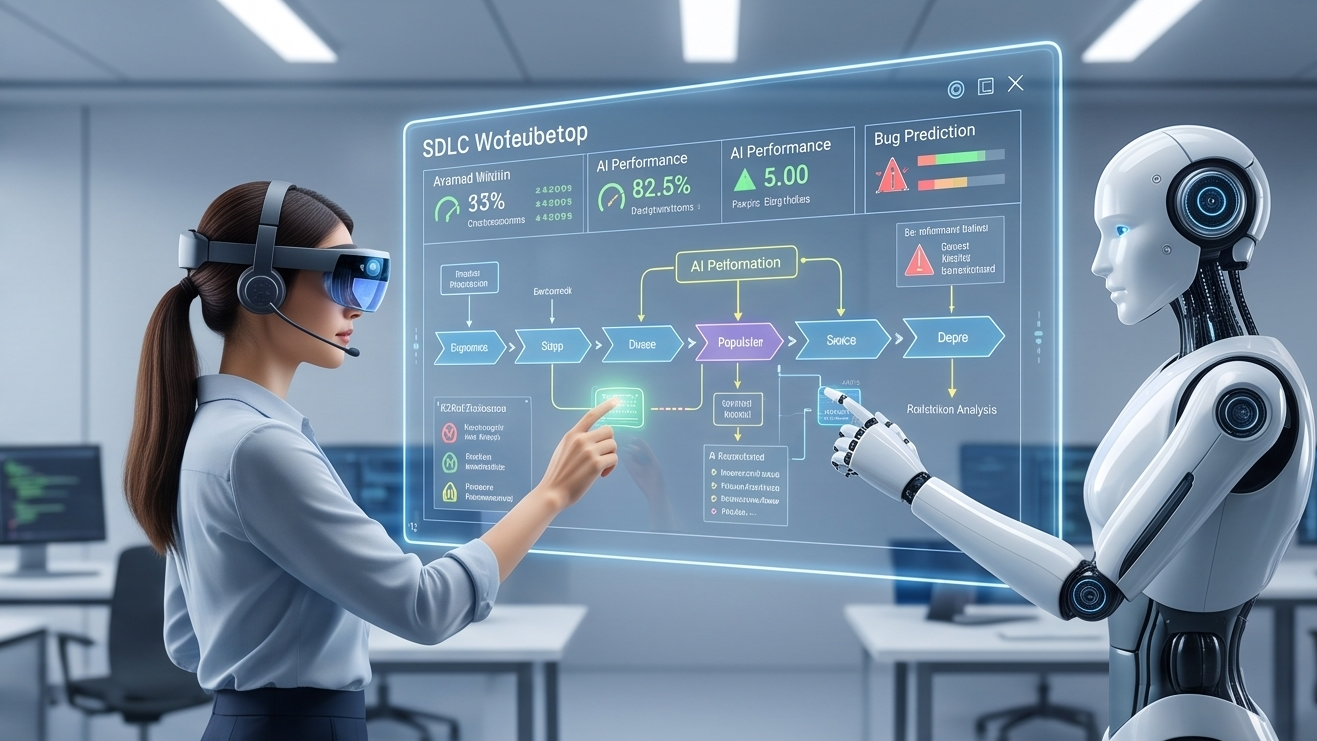
Tests as the New Requirements
In the traditional SDLC, requirements were a document handed off between teams. In the AI-driven SDLC, tests and evaluations become the primary mechanism for communicating intent to AI agents.
Instead of writing step-by-step instructions for an agent, QA engineers must define success criteria. A well-written evaluation suite tells the AI what "correct" means and provides the automated environment for the agent to verify its own work.
Furthermore, AI transforms the test generation process itself:
Agents can produce test cases, edge cases, and property-based tests that humans might otherwise miss.
AI can act as a first-pass code reviewer, identifying potential bugs, style violations, security vulnerabilities, and performance issues before a human reviewer even sees the code.
The Continuous Quality Flywheel
To manage the rapid output of coding agents, QA must wire these new practices into a continuous quality flywheel. This process includes:
Evaluating agent output against a benchmark suite.
Diagnosing failures by clustering the root causes.
Optimizing the prompts or tools that caused those
failures.
Verifying the fixes against a regression suite.
Monitoring production traffic for entirely new failure modes.
The 80% Problem: Where Human QA Excels
Despite rapid advancements, AI models still face the "80% problem". AI agents can rapidly generate approximately 80% of the code for a feature, but the remaining 20% demands deep contextual knowledge that current models often lack.
This final 20% encompasses the edge cases, error handling, integration points, and subtle correctness requirements. AI errors have evolved from simple syntax mistakes to insidious conceptual failures, such as making wrong assumptions about business logic
or missing edge cases. These are harder to detect because the code often "looks right" and might even pass basic tests.
The Future of the QA Engineer
The human role in QA is not diminishing; it is evolving. As implementation becomes highly automated, the true value of an engineer shifts to specification, evaluation, and architectural judgment. Generation is a solved problem; verification, judgment, and direction are the new craft.